|
Elk Rapids Almanac for November 2017
November 4-My walk in the freezing sleet was rewarded with the song of a loon, two beautiful herons, and three swans in Memorial Park--Terri Reisig. November 5-Is there anything more awesome and majestic than watching a bird in flight or almost soundlessly landing on the water?--Kathy Petersen November 10-If you happen to hike at Maple Bay Park, you may see a pile of tarps covering something. That "something" is a tree that was cut down by contractors working with Grand Traverse Regional Land Conservancy (GTRLC) and Grand Traverse County Parks and Recreation Department due to identified Oak Wilt. The tree removed has the Oak Wilt fungus in it. It will be covered for a full year to prevent the fungus from spreading. According to GTRLC staff, "Oak Wilt travels two ways: via spores attached to insects, or by root graft with neighboring oak trees". Thanks to the Conservancy and Grand Traverse County for being proactive on this issue--Gary Stauffer-Green Elk Rapids member and Preserve Steward at Maple Bay. November 12-A wild turkey appears at my window to retrieve seed thrown from my feeder by the Blue Jays in Meadowview Common--Linda Travis. November 13-Studies have confirmed the health benefits of spending time in nature. Walking in a forest can lower blood pressure, reduce pulse rate, anxiety and depression. In Japan, "forest bathing" or Shinrin-Yoku is popular. Their residents who stroll in the forest are believed to benefit from breathing organic compounds that result in better physical and emotional health. In fact, we now know that trees actually communicate with each other and their root systems are intimately connected with one another--Gary Stauffer. November 15-Moments connecting with nature…Looking out the kitchen window I discover a big woodpecker on our dead tree out front. At first glance it has a red head, a big peak, gray underside and is furiously digging for bugs. I pick up our field identification Birds of North America book, assured that I can put a name on our visitor. Wow! Can there be any more varieties of Woodpeckers? Now I know why the book cost is so high!--Kathy Peterson. |
Out My Window
November’s tears streak my window panes as Her cold wind burlesques the trees and Grasses snatch the orange, yellow, red tattered cloaks. Black squirrels bound with bulging jaws to their burial tasks While fluffy coated resident rabbits shelter Under cone heavy evergreen boughs. Hairy woodpeckers gulp globs of fat, Their red-striped heads jack hammering the suet. Crimson cardinals and dark jacketed juncos Inspect the ground for cast-off seeds. Jittery black capped chickadees flee the incoming, Shrieking bully blue jays as their Flights to the feeder split the slate gray skies. In silence I await the anticipated white coverlet which Will brighten the dark ground and glisten in sunlight. All out my window as November morphs to December. Linda Travis – November 2017 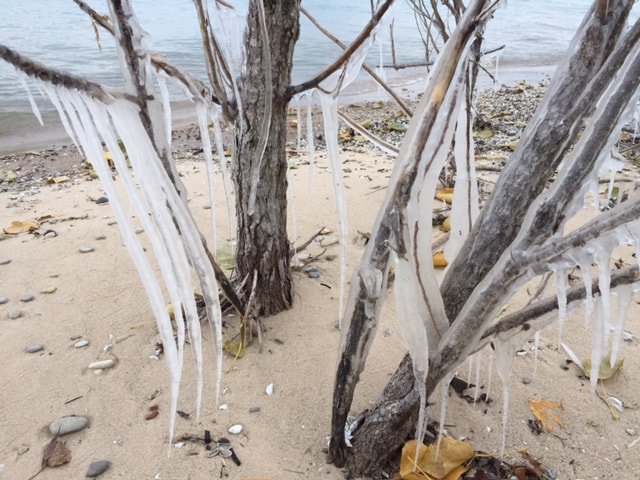
Photo by Teri Reisig
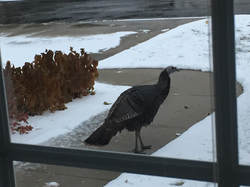
Wild turkey. photo by Linda Travis
|